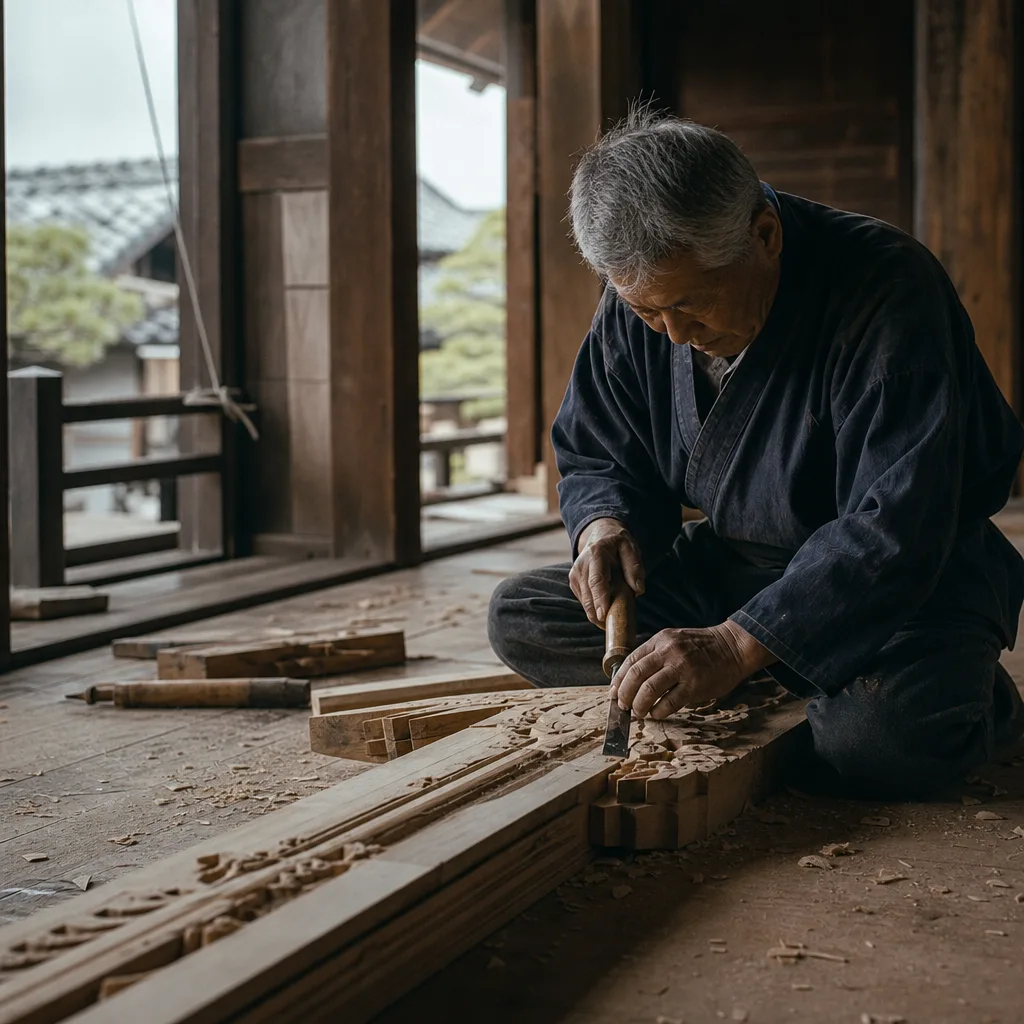
How a guild of woodworkers raised temples without a single nail — and why some still stand a thousand years later.
The great halls of Kyoto were built by men who refused to use iron. Where a European cathedral relied on nails, dowels, and eventually bolts, the miyadaiku carpenters of Japan cut interlocking joints so precise that the timber itself did the fastening. A beam slots into a post, a bracket cradles a beam, and the whole frame holds by geometry and gravity alone.
The reason was not superstition but survival. Kyoto sits in an earthquake country, and a rigid, nailed structure cracks when the ground moves. A jointed frame flexes: the timbers shift against one another, absorb the shock, and settle back. The soaring five-storey pagoda of To-ji has ridden out a millennium of tremors that flattened sturdier-looking buildings around it, thanks in part to a free-swinging central pillar that sways like a pendulum against the motion of the floors.
We know how these guilds worked because their knowledge was never fully written down. It passed from master to apprentice over decades, encoded in the tools themselves and in the ritual of the periodic rebuild, when a shrine is dismantled and reconstructed exactly, board for board, so the skill is transmitted through the hands of the next generation.
Replace this text with your own research: the temples you have studied, the sources you drew on, and the questions still left open.